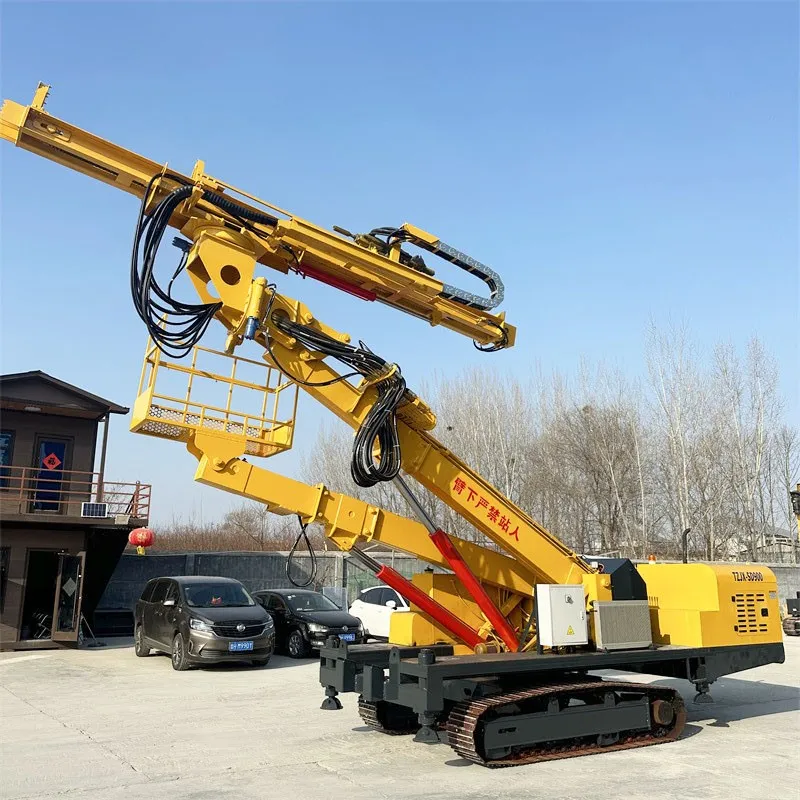
The main components of a tunnel drilling rig include a power unit (set), rotary head, drill string pulling mechanism, and drill string unloading device. It generally does not have a drilling tower (mast) and is usually fixed to a single-leg or double-leg column for operation. Its design must adapt to the space constraints of tunnels, featuring modularity, good disassembly, lightweight, flexible layout, and easy relocation.
Modern tunnel drilling rig designs tend to divide the rig into four functional modules: power, transmission, control, and support, enabling rapid replacement and assembly through standardized interfaces. Compared to traditional monolithic structures, modular drilling rigs can improve handling efficiency by approximately 40%, increase drilling speed by 20%, and reduce energy consumption by 15%.
Many tunnel drilling rigs adopt a split structure, such as consisting of a main unit, pump station, and control panel. This design facilitates relocation and transportation within narrow tunnels.
The hydraulic system of a fully hydraulic tunnel drilling rig mainly consists of a pump station, control panel, and power head. It adopts a dual-pump oil supply (large pump for rotation, small pump for propulsion and auxiliary actions), and features stepless speed regulation, smooth transmission, simple operation, and strong adaptability.