

Hey there! As a supplier of Crawler Guardrail Pile Drivers, I'm super stoked to chat with you about the pile - driving depth control method of these bad boys.
First off, let's understand why pile - driving depth control is so crucial. When you're installing guardrails, getting the right pile - driving depth is like nailing the foundation of a house. It ensures the stability and safety of the guardrail. If the piles are driven too shallow, the guardrail might not be able to withstand the impact of a vehicle collision. On the other hand, driving the piles too deep can be a waste of time and energy, and it might even damage the equipment or the ground.
So, what are the methods to control the pile - driving depth of a Crawler Guardrail Pile Driver?
1. Manual Measurement Method
This is the most basic and straightforward method. Before starting the pile - driving process, you mark the desired depth on the pile itself. You can use a measuring tape to measure the distance from the top of the pile to the point that represents the required depth and then make a clear mark.
During the pile - driving operation, an operator keeps an eye on the pile. As the pile is being driven into the ground, once the marked point reaches the ground level, it indicates that the pile has been driven to the desired depth. This method is simple and doesn't require any high - tech equipment. However, it heavily relies on the operator's attention and accuracy. A small mistake in marking or observation can lead to inaccurate pile - driving depth.
2. Depth Indicator Sensors
Modern Crawler Guardrail Pile Drivers often come equipped with depth indicator sensors. These sensors are installed on the pile - driving equipment. They work by measuring the distance that the pile has been driven into the ground.
There are different types of depth indicator sensors. For example, some use ultrasonic technology. The ultrasonic sensor emits ultrasonic waves towards the ground, and then it measures the time it takes for the waves to bounce back. Based on the speed of sound in the air and the time measurement, the sensor can calculate the distance between the sensor and the ground, which is related to the pile - driving depth.
Another type is the laser - based depth indicator. It projects a laser beam onto the ground and measures the change in the position of the laser spot as the pile is being driven. This allows for a more accurate measurement of the pile - driving depth.
The advantage of using depth indicator sensors is that they provide real - time and accurate depth information. They reduce the reliance on human observation and can significantly improve the precision of pile - driving. However, these sensors can be quite expensive, and they need to be properly maintained to ensure their accuracy.
3. Hydraulic Pressure Control
In some Crawler Guardrail Pile Drivers, hydraulic pressure is used to control the pile - driving depth. The pile - driving equipment is powered by a hydraulic system. As the pile is being driven into the ground, the resistance from the ground increases. The hydraulic pressure in the system also changes accordingly.
By setting a specific hydraulic pressure threshold, the operator can control the pile - driving depth. When the hydraulic pressure reaches the pre - set threshold, it indicates that the pile has reached a certain depth where the ground resistance has increased to a level that corresponds to the desired depth.
This method is relatively simple and can be integrated into the existing hydraulic system of the pile - driver. However, the relationship between hydraulic pressure and pile - driving depth can be affected by many factors, such as the type of soil, the shape and size of the pile. So, it might not be as accurate as the sensor - based methods in some cases.
4. GPS - Based Depth Control
GPS (Global Positioning System) technology has also been applied to pile - driving depth control. With a GPS receiver installed on the pile - driving equipment, it can accurately determine the position of the pile in three - dimensional space.
By comparing the initial position of the pile with its position after being driven into the ground, the system can calculate the pile - driving depth. GPS - based depth control offers high - precision measurement, especially in large - scale construction projects where the geographical location and elevation need to be considered.
It can also provide detailed data about the pile - driving process, which can be used for quality control and project management. However, GPS signals can be affected by factors such as buildings, trees, and bad weather conditions. So, in some situations, the accuracy of GPS - based depth control might be compromised.

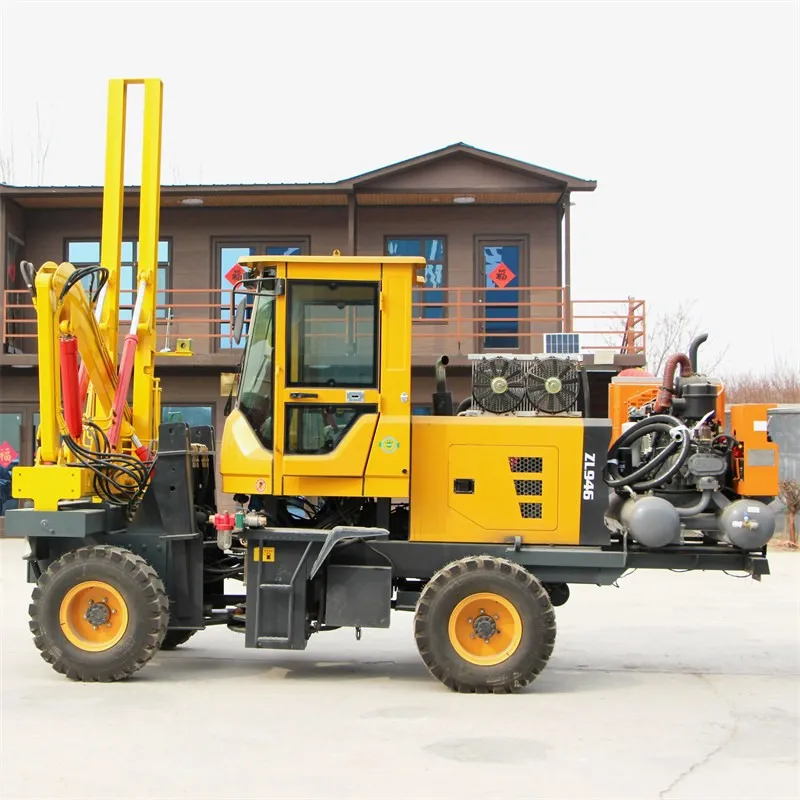
Now, let me tell you a bit about our products. We offer a wide range of pile - driving equipment, including the Small Four Wheel Pile Driver, Highway Guardrail Piling Machine, Highway Guardrail Post Driver, Spiral Pile Machine, and of course, the Crawler Guardrail Piling Machine.
Our Crawler Guardrail Pile Drivers are designed with advanced technology and high - quality materials. They are easy to operate and maintain, and they come with reliable pile - driving depth control methods. Whether you're working on a small - scale project or a large - scale highway construction, our products can meet your needs.
If you're interested in our products or have any questions about pile - driving depth control, feel free to get in touch with us. We're always here to help you make the right choice for your project.
References
- Construction Equipment Handbook: Pile - Driving Technology
- Journal of Civil Engineering: Advanced Pile - Driving Methods and Equipment